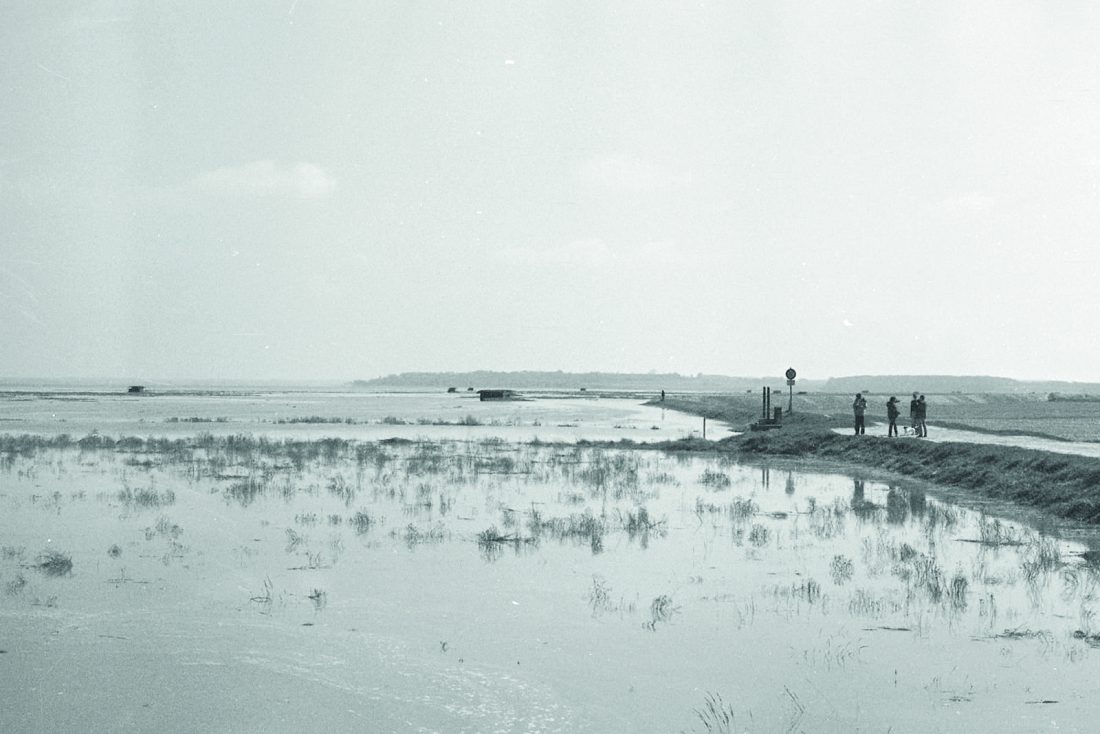
Rendre à la mer
Révéler un littoral en transformation – Bas-Champs de Cayeux
2025
Auteur(s)
Lilian Marchand
Enseignant(s)
Martin Gillot, Minh Nguyen
Département
AAP
Situés au sud de la Baie de Somme, les Bas-Champs de Cayeux est un territoire maritime modelé par l’homme depuis plusieurs siècles. Confronté au changement climatique, ce littoral doit aujourd’hui revoir sa démarche d’adaptation aux enjeux environnementaux locaux, comme la montée des eaux et l’ensablement de la baie, pour continuer d’exister.
L’une des solutions envisagées pour protéger à la fois la plaine maritime face aux risques de submersion, et l’estuaire contre l’ensablement, est la dépoldérisation partielle du territoire. Ce processus, consistant à accompagner le retour de la mer, représente une approche alternative et environnemental de gestion des littoraux. Une telle transformation du territoire soulève une question essentielle : comment continuer d’habiter ce territoire ?
En s’appuyant sur la dépoldérisation d’une parcelle au nord des Bas-Champs, ce projet propose de penser le retour de la mer comme une opportunité de cohabiter avec elle. Il envisage une série d’objets architecturaux permettant d’offrir un nouveau regard sur ce paysage singulier, ainsi que sur les phénomènes naturels qui le façonnent.
Version numérique en ligne (réservée aux abonnés ArchiRès)
Located in the south of the Baie de Somme, the Bas-Champs de Cayeux are a landscape that has been shaped by humans over centuries in order to reclaim farmland from the sea. Today, however, this landscape is facing major environmental challenges, including rising sea levels and the gradual silting up of the estuary.
One of the solution being considered to protect the maritime plain from flooding and the estuary from silting is the partial ‘controlled realignment’ of the land. This process, which is still rarely implemented in France, offers an environmentally friendly approach by accepting the return of the sea and working with it.
To explore new ways of living with these landscapes, the project involves the controlled realignment of an agricultural plot. Rather than viewing the return of the sea as a loss, the project proposes seeing it as an opportunity for respectful coexistence with natural dynamics.
Through a series of architectural and landscape interventions, the project aims to offer a fresh perspective on this distinctive territory and reveal the natural processes that shape it.