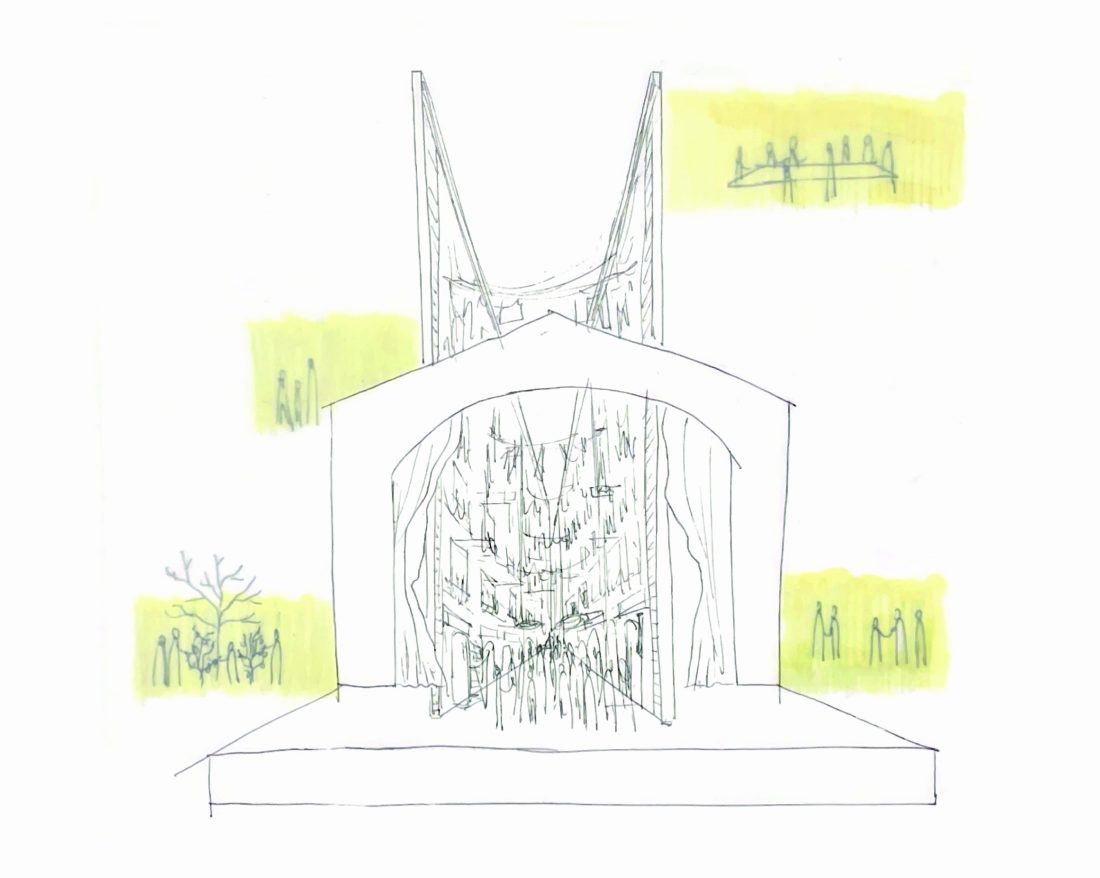
Ré-habiter les failles urbaines
Le centre historique de Naples entre tourisme, biens communs et patrimoine confisqué
2025 Double Diplôme Université de Naples
Auteur(s)
Ludovica Prisco
Enseignant(s)
Maria Salerno, Marco Assennato, Maria Salerno, Marco Assennato
Département
AAP
La recherche prend forme à partir d’une immersion perceptive dans le tissu dense et stratifié du centre ancien de Naples, avec l’objectif de lire, comprendre et inter-préter les transformations et les tensions du présent.
Le projet cherche une faille dans un espace urbain de plus en plus comprimé par la touristification – un phénomène qui semble aplatir la matière tangible de la ville en une scénographie, et expulser ceux qui en font profondément partie.
La brèche identifiée pour reconstruire un espace d’habitabilité profonde se trouve dans les biens confisqués à la camorra : fragments difficiles, hétérogènes et dispersés, mais porteurs d’un potentiel symbolique et pratique.
Soustraits à un système d’anti-ville, ils deviennent des lieux paradigmatiques pour contrer les logiques de marchandisation et imaginer des processus de restitution de l’espace urbain – du droit à la ville – en tant que bien commun, capable d’accueillir de nouvelles pratiques de l’habiter.
Re-Inhabiting Urban Fractures
Naples’ Historic Center between Tourism, Commons, and Confiscated Heritage
This research emerges from a perceptual immersion in the dense and stratified fabric of Naples’ historic center, with the aim of reading, understanding, and interpreting the contemporary urban transformations and tensions.
The project seeks out a fracture within an urban space increasingly compressed by the forces of touristification—a phenomenon that appears to flatten the tangible substance of the city into a stage set, while displacing those who are most intimately part of it.
The breach identified as a potential site for reconstructing a profound habitability lies in the properties confiscated from the Camorra: challenging, heterogeneous, and scattered fragments, yet imbued with both symbolic and practical potential.
Removed from a system of anti-city, these spaces become paradigmatic loci from which to resist commodification and envision new processes of urban restitution—of the right to the city—as a common good, capable of hosting alternative forms of inhabiting.