(Im)permanences
Penser la pérennité par le prisme de l’urgence
2025
Auteur(s)
Belen Laqueche
Enseignant(s)
Colin Reynier, Soline Nivet
Département
PASS
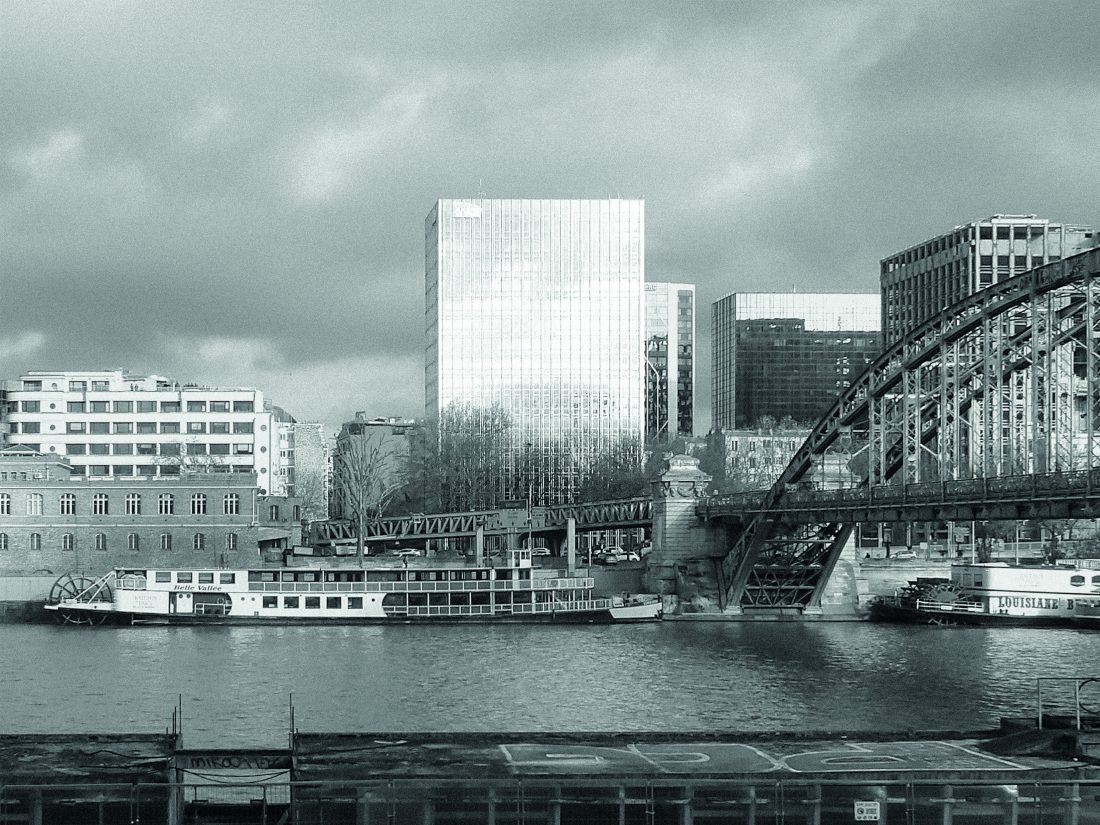
Face à la multiplication des crises climatiques, humanitaires et sociales et en réaction à l’obsolescence du parc tertiaire francilien, ce projet envisage la transformation de la tour Bercy-Rapée II (1976) de Jean Dubuisson à Paris, en structure capable d’accueillir des dispositifs d’hébergement d’urgence. Cet édifice de bureaux, hérité du modernisme, a en effet atteint de manière précipitée la fin de son premier cycle de vie et résulte en une chimère mutique en discordance totale avec son environnement, une absurdité dans une ville confrontée à des enjeux de densification.
Dans ce quartier d’arrivée marqué par l’invisibilisation de la précarité, le projet énonce un postulat politique : celui de se saisir de ce volume capable vacant pour y déployer de l’hébergement d’urgence ; de trouver abri et confort en plein cœur de Paris, dans une architecture monumentale issue des Trente Glorieuses. Un outil d’accueil à grande échelle, conçu par et pour l’urgence.
Dans une réflexion plus générale sur la réversibilité du déjà-là, il s’agit de considérer le variable comme matière à projet, entre incertitude climatique, fluctuation programmatique, scénarii d’occupation variés, etc. En proposant des formes d’habitats transitoires qui répondent à diverses temporalités dans le parcours d’exil, l’intervention permet de transformer un édifice rigide, statique et imperméable en un système poreux et évolutif, à une multitude d’échelles. Une architecture qui ne cherche pas à stabiliser l’incertitude, mais à l’accueillir.
Version numérique en ligne (réservée aux abonnés ArchiRès)
In the face of growing climate, humanitarian, and social crises—and in response to the obsolescence of Paris’s office building stock—this project explores the transformation of the Bercy-Rapée II tower (1976) by Jean Dubuisson into a flexible structure capable of hosting emergency accommodation.
Originally built as a modernist office tower, the building has prematurely reached the end of its first lifecycle. It now stands as a silent relic, disconnected from its surroundings—an anomaly in a city confronting pressing densification challenges.
Set in a neighborhood where social precarity is often rendered invisible, the project makes a political proposition: to reclaim this vacant, generous volume and turn it into a space for shelter and comfort, right in the heart of Paris—within the monumental legacy of the postwar boom. It becomes a large-scale infrastructure for care, conceived with and for urgency.
On a broader level, the project is an exploration of how to work with the existing—not as a constraint, but as a dynamic, open-ended material. It embraces variability as a core design driver: from climatic instability and shifting programs to diverse patterns of occupation. Through transitional forms of dwelling that respond to different stages of displacement, the intervention reimagines a rigid, static, and closed structure as a porous, adaptive system that operates across multiple scales. Offering an architecture that doesn’t attempt to resolve uncertainty, but rather to accommodate it.