Repenser Paris depuis ses toits
Un guide pour faire face à 50°C
2025
Auteur(s)
Marion Kaazan
Enseignant(s)
Colin Reynier, Soline Nivet
Département
PASS
À Paris, les toits en zinc ne servent pas seulement à couvrir les bâtiments : ils protègent, signalent l’habitat et contribuent à l’identité de la ville.
Emblèmes du ciel parisien, ces toitures mal isolées abritent souvent des logements précaires. Étant de véritables passoires thermiques, la situation des combles ne fera que s’aggraver avec le dérèglement climatique. Néanmoins, la nécessité d’une réhabilitation thermique offre l’opportunité de repenser les manières de dessiner et d’habiter les toits et combles, en les reconnectant au sol et au sous-sol.
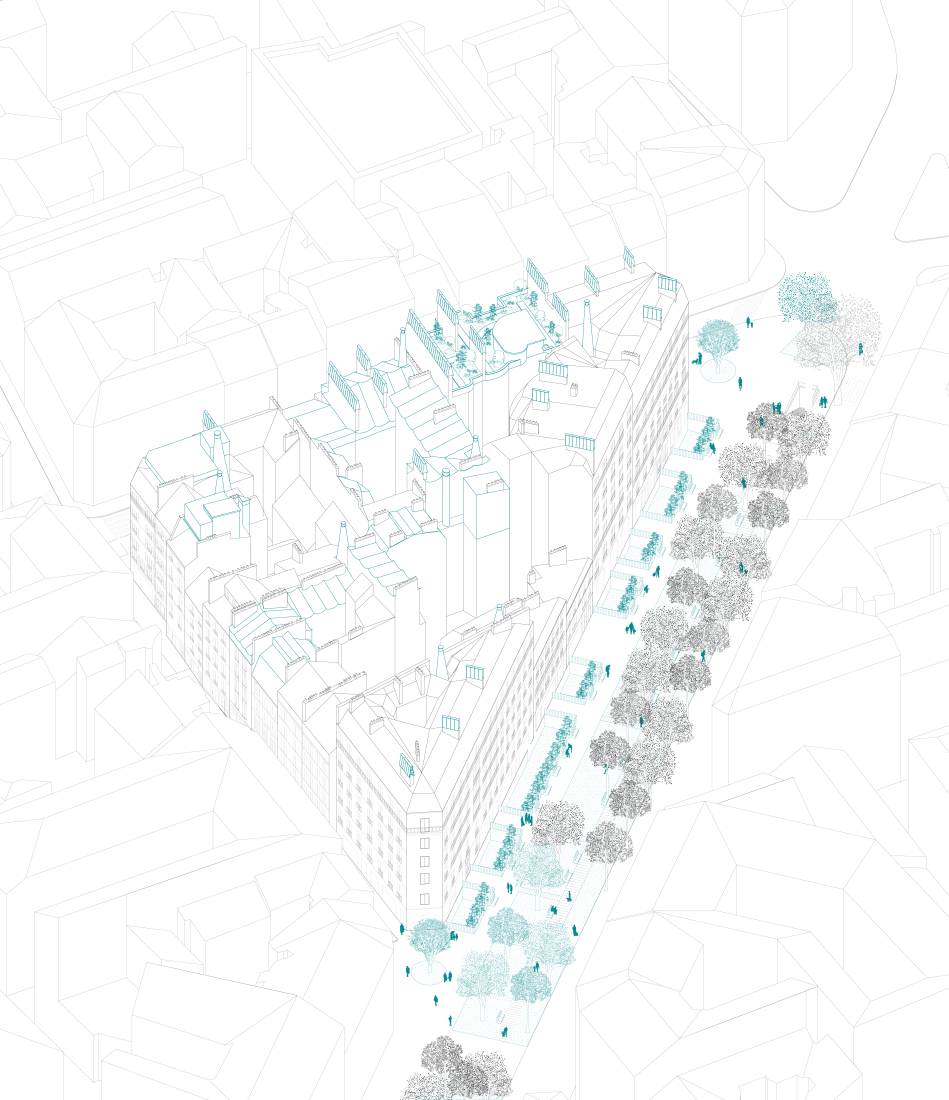
En prenant pour terrain d’étude un îlot du 7ᵉ arrondissement, ce travail propose une méthode de transformation à la fois climatique et spatiale, conciliant adaptation et création de nouveaux communs. Par une approche typologique, il établit un socle de prescriptions transposables à l’échelle de Paris.
Ce projet s’accompagne d’un guide inspiré des revues de vulgarisation scientifique, destiné à rendre les enjeux architecturaux accessibles à toutes et tous, afin de donner les moyens de participer à la transformation de la ville.
In Paris, zinc roofs aren’t just used to cover buildings: they also protect and signal homes and contribute to the city’s identity.
Emblems of the Parisian skyline, these poorly insulated roofs are often home to precarious dwellings. As genuine heat wasters, the situation of attics will only worsen with climate change. Nevertheless, the need for thermal renovation provides an opportunity to rethink the way roofs and attics are designed and lived in, by reconnecting them to the ground and the basement.
Using a block in the 7ᵉ arrondissement as a field of study, this work proposes a method of transformation that is both climatic and spatial, reconciling adaptation and the creation of new common areas. Using a typological approach, it establishes a set of guidelines that can be transposed to the entire city of Paris.
The project is accompanied by a guide, inspired by magazines that popularise science, designed to make architectural issues accessible to everyone, so as to provide the means to participate in the transformation of the city.