Archéologie fictionnelle
L’anomalie historique comme projet
2025
Auteur(s)
Mathilde Brunet
Enseignant(s)
Jean-Pierre Vallier, Florian Bosc Malavergne
Département
THP
Le patrimoine architectural est le cœur de deux pratiques aujourd’hui distinctes, l’architecture et l’archéologie. Ce projet se veut un manifeste pour la rencontre entre architecte et archéologue, replaçant le vestige architectural au centre de leurs préoccupations respectives.
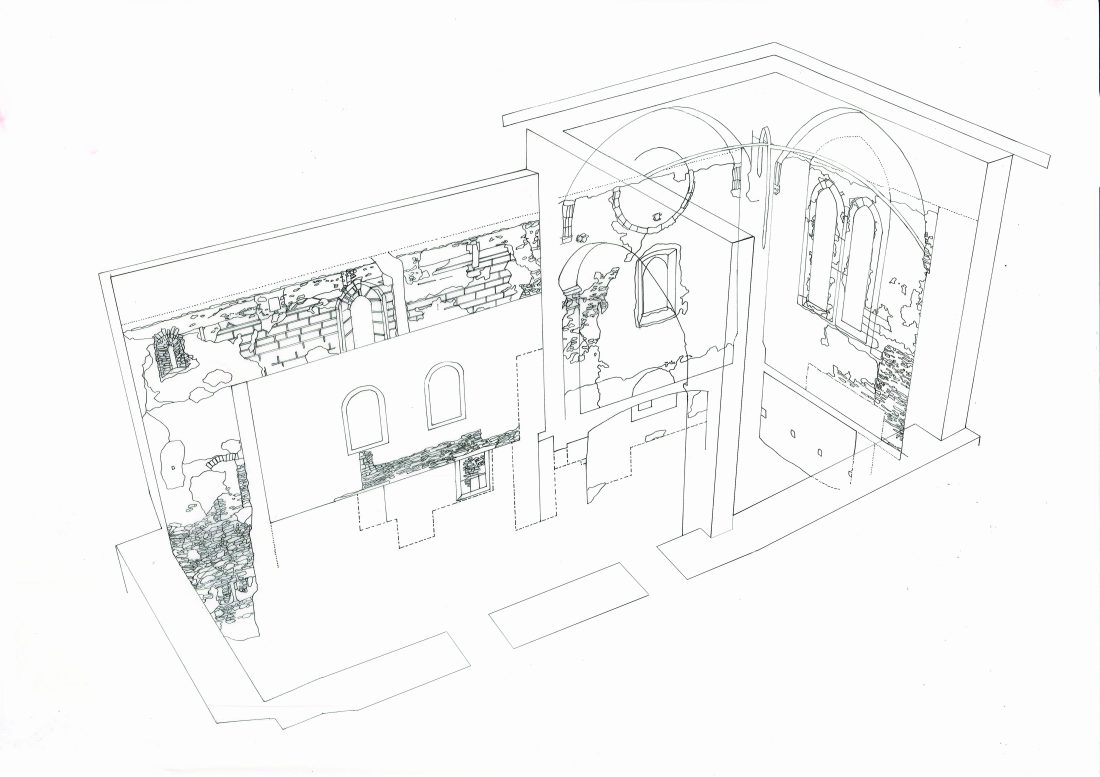
En se penchant sur le cas de l’église médiévale de la chartreuse de Sainte-Croix-en-Jarez, ce projet exploite conjointement les outils de l’archéologue et de l’architecte : les spécificités de l’un pallient aux limites de l’autre, et inversement. Des anomalies architecturales et archéologiques détectées par l’archéologue naissent des questions sans réponse ; l’architecte fait naitre de ces incompréhensions une archéologie-fiction.
De la plus discrète présence de trace dans la pierre, de sa plus petite absence relevée par l’archéologue, l’architecte extrait une matière nouvelle qui vient retracer l’histoire imaginaire du lieu. À travers plusieurs siècles, des architectures inventées projettent des usages, des ambiances, toute une vie d’espaces qui n’ont jamais existé, mais qui, sans doute, auraient pu le faire.
Architectural heritage is the core of two practices that are nowadays very distinct : architecture and archaeology. This project is intended as a manifesto for the encounter between architect and archaeologist, placing the architectural remains at the heart of their respective preoccupations.
Focusing on the medieval church of the Carthusian monastery of Sainte-Croix-en-Jarez, this project makes joint use of the tools of both archaeologists and architects : the specific features of one make up for the limitations of the other, and vice versa. The architectural and archaeological anomalies detected by the archaeologist give rise to unanswered questions; the architect turns these misunderstandings into archaeology fiction.
From the most discreet trace in the stone, from the smallest absence identified by the archaeologist, the architect extracts new material that tracks down the fictional history of the site. Over the course of several centuries, invented architectural uses, atmospheres and a whole ecosystem of spaces that never existed, but undoubtedly could have.