Vents nouveaux
Stratégies architecturales pour les étés de demain
2025
Auteur(s)
Ambre Leronseur
Enseignant(s)
Loïc Couton, Marc Benard
Département
Transitions
Le changement climatique impose une transformation profonde de notre manière de concevoir, d’habiter et de transformer la ville. À Paris, les épisodes de canicule se multiplient, mettant à l’épreuve un parc immobilier souvent inadapté à ces nouvelles conditions climatiques. Dans ce contexte, la reconversion de bâtiments vacants, notamment les bureaux des années 1970, constitue une opportunité stratégique pour répondre à la double exigence du logement et de la résilience climatique.
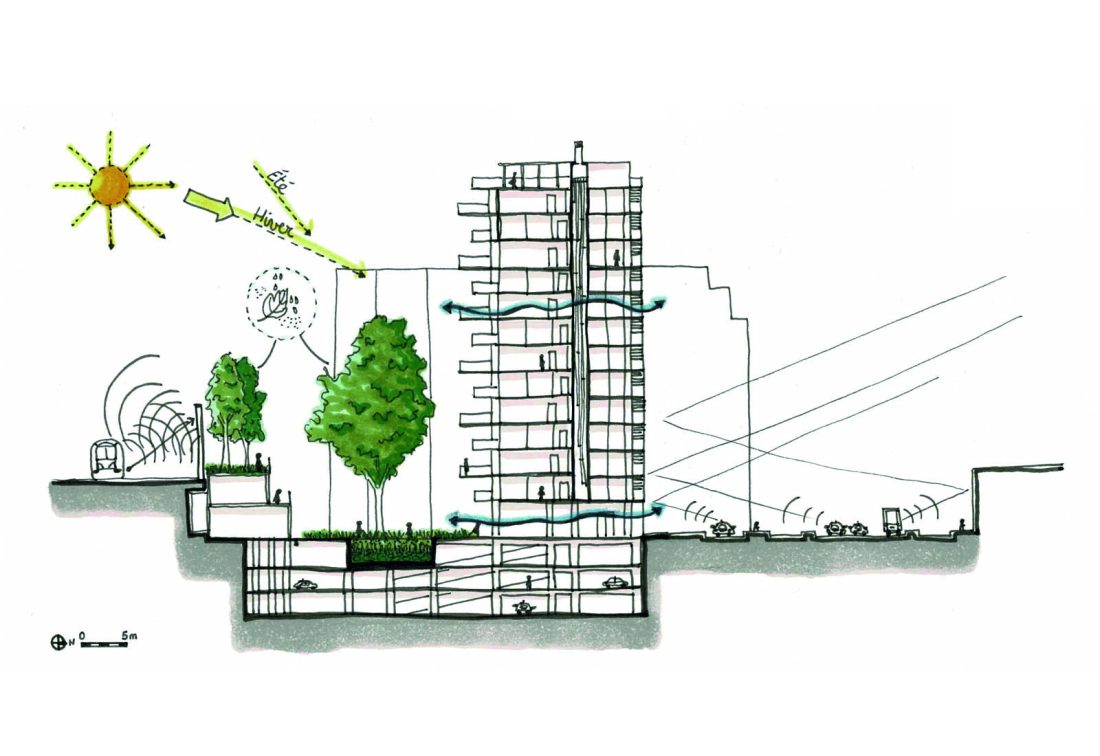
Ce projet explore le potentiel d’une transformation bioclimatique d’un immeuble situé au 105-109 bd Macdonald, dans le XIXe arrondissement de Paris. L’ambition est claire : transformer un bâtiment en logements confortables en été, sans dépendre de systèmes énergivores, en s’appuyant sur des ressources naturelles. À travers une analyse de l’existant, une réflexion sur les stratégies de ventilation naturelle et la conception de solutions architecturales adaptées, ce projet propose des pistes concrètes pour imaginer des étés urbains plus vivables, où l’architecture anticipe le climat au lieu de le subir.
Climate change is forcing a profound transformation in the way we design, live in and transform our cities. In Paris, heatwaves are multiplying, putting to the test a building stock that is often ill-adapted to these new climatic conditions. In this context, the conversion of vacant buildings, particularly offices dating from the 1970s, represents a strategic opportunity to meet the dual requirements of housing and climate resilience.
This project explores the potential of a bioclimatic transformation of a building at 105-109 bd Macdonald, in the 19th arrondissement of Paris. The ambition is clear: to transform a building into comfortable accommodation in summer, without relying on energy-intensive systems, using natural resources.
Through an analysis of the existing situation, a reflection on natural ventilation strategies, and the design of adapted architectural solutions, this project proposes concrete ways of imagining more liveable urban summers, where architecture anticipates the climate rather than being subjected to it.