(A)ménager les sols vivants
Une expérience de la sobriété foncière à La Souterraine
2026
Auteur(s)
Grégoire Chiriac, Marine Coin
Enseignant(s)
Thierry Mandoul, Alice Sotgia
Département
AAP
La sur-artificialisation des sols et ses conséquences – érosion de la biodiversité, îlots de chaleur, intensification des catastrophes climatiques – rappellent aux architectes leur responsabilité environnementale. Si la connaissance scientifique et l’action publique se sont emparées de la préservation des sols avec le ZAN, il est de notre rôle de replacer l’écosystème des sols au centre du projet.
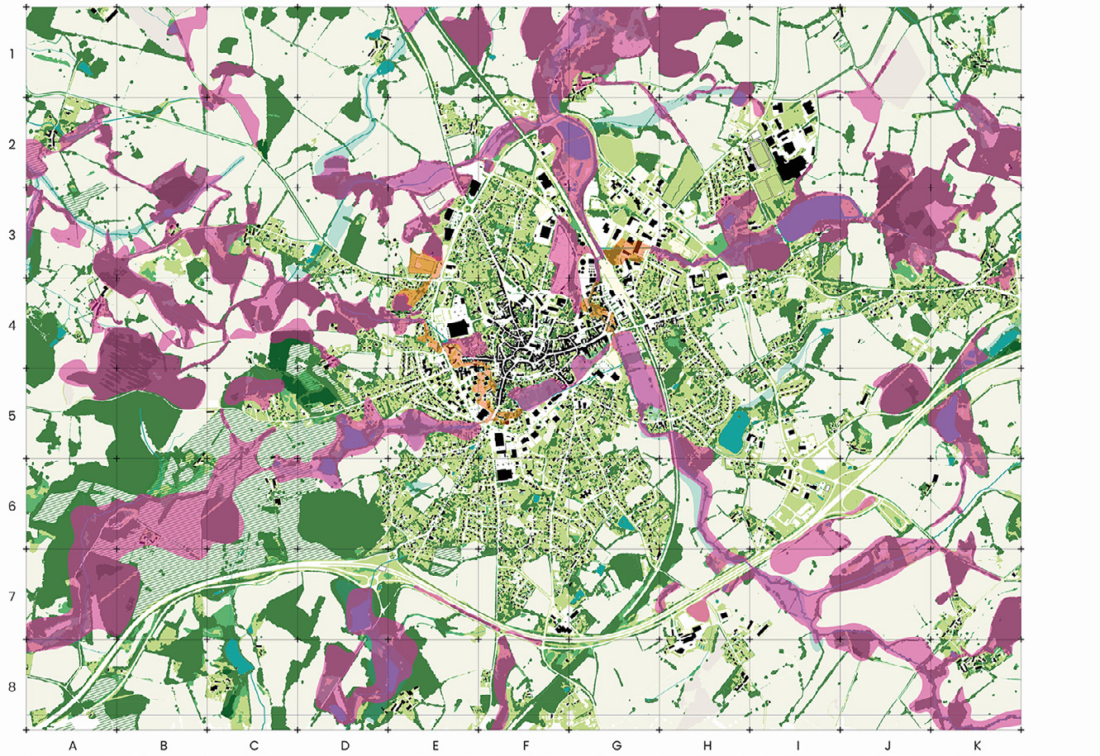
Nos arpentages et entretiens en Nouvelle- Aquitaine ont nourri un autre regard sur la sobriété foncière : plus que d’étalement urbain, il est question de sauvegarde des sols vivants en ville. Notre démarche de projet, partant de la cartographie des valeurs des sols à La Souterraine, révèle les potentialités de cohabitation avec le vivant. Chaque rupture des corridors est une invitation au projet, un moyen de soigner les sols et le bâti.
Ainsi îlot dégradé, friche commerciale et lotissement, en s’articulant à la continuité écologique restaurée, deviennent des leviers de résilience. Ce tracé, support pédagogique entre la ville et son grand paysage, s’inscrit alors dans un projet territorial du vivant.
Consultable à la bibliothèque de l’école
The excessive artificialization of land and its consequences – biodiversity loss, heat islands, and more frequent climate-related disasters – serve as a reminder to architects of their environmental responsibility. While scientific knowledge and public policy have taken up the cause of soil conservation through the ZAN objective, it is our role to put the soil ecosystem back at the center of the project. Our land surveys and interviews in Nouvelle-Aquitaine have fostered a new perspective on land sobriety : rather than urban sprawl, the focus is on safeguarding living soils within cities.
Our project approach, beginning with the mapping of soil values in La Souterraine, reveals the potential for coexistence with living organisms. Each break in the corridors is an invitation to take action, a means of caring for the soil and the built environment. Thus, degraded buildings, commercial wastelands, and housing developments – by connecting to the restored ecological continuity – become drivers of resilience. This route, serving as an educational link between the city and its broader landscape, is part of a territorial project centered on living ecosystems.
Monaco, terrain d’essai du néolibéralisme (Mention recherche Grégoire Chiriac)
Against a backdrop of questioning of human pressure on land, examining our most extreme examples of land artificialisation provides a means of understanding how we shape society through urban planning. Monaco is a perfect example of a territory saturated by human activity. Its urban policy – invisible yet characterised by proven human intervention and fuelled by land speculation – must be re-examined in order to grasp the current role of the economy in urban policies. By treating Monaco’s unique and incremental development as a precursor to the neoliberal city, its study provides deeper insight into the long-term consequences of the financialisation of the city.
Anachronisme des stations de sports d’hiver (Mention recherche Marine Coin)
Winter sports resorts : veritable laboratories of architecture. The development of mountain areas is the result of ambitious public policies and changing economic contexts, and is now threatened by climate change. In less than half a century, a model has emerged, and resorts have sprung up throughout the Alps. Their architecture has evolved : the expansion of existing villages, the creation of veritable snow metropolises on virgin land, and today a question looms large : what will become of them? This research thesis traces the story of a success, but also the tale of a downward spiral that we must now collectively address, because whilst we continue to build them, the mountains are warming.