Habiter l'impermanence
Une membrane biodégradable au biochar comme outil de remédiation du sol
2026
Auteur(s)
Grégoire Gagneux
Enseignant(s)
Frank Minnaërt, Anahita Mirani
Département
DM
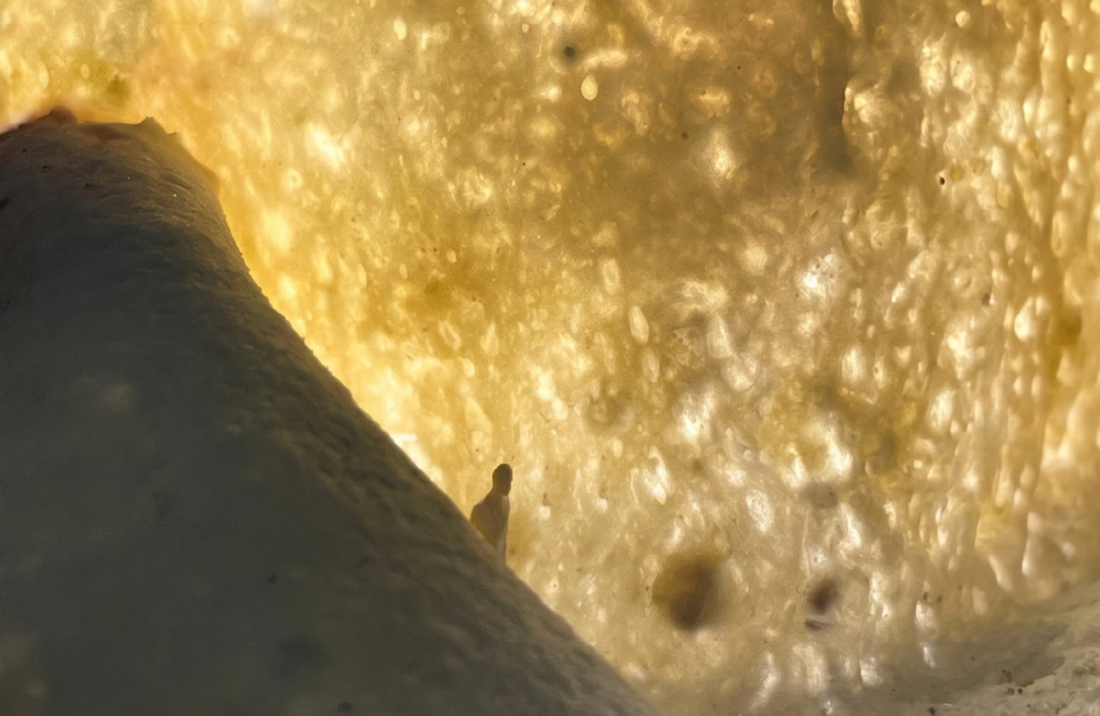
Face aux transformations environnementales contemporaines et à la nécessité de repenser l’impact du bâti sur ses écosystèmes, l’architecture s’ouvre aujourd’hui à des démarches qui réintègrent la matière dans des cycles de vie naturels, cherchant un état de symbiose avec son environnement. Ce projet explore la possibilité d’utiliser des membranes fines aux caractéristiques biodégradables dans un contexte architectural.
Encore en phase d’exploration, ces membranes ouvrent un champ d’investigation où la forme bâtie n’est plus pensée comme un objet permanent, mais comme une structure éphémère, vouée à apparaître, se transformer puis disparaître sans laisser de trace toxique.
Les différentes phases de prototypage ont ouvert de nombreuses questions quant à la manière de concevoir avec des matériaux organiques : comment penser une structure en anticipant sa fin ? Comment intégrer la temporalité de la dégradation comme paramètre spatial ?
Le site de la Petite Ceinture sert de terrain d’expérimentation pour cibler une problématique réelle : celle des sols urbains pollués. En travaillant avec des membranes biodégradables, le projet interroge la possibilité de créer des interventions architecturales à faible impact, capables d’exister de manière temporaire sur un sol fragile, sans l’alourdir davantage de matériaux persistants.
In response to contemporary environmental transformations and the need to rethink the impact of built structures on their ecosystems, architecture is now opening up to approaches that reintegrate matter into natural life cycles, seeking a state of symbiosis with its environment. This project explores the possibility of using thin membranes with biodegradable properties in an architectural context.
Still in an exploratory phase, these membranes open up a field of investigation in which built form is no longer conceived as a permanent object, but as an ephemeral structure, destined to appear, transform, and then disappear without leaving a toxic trace.
The various prototyping phases have raised numerous questions about how to design with organic materials: how can a structure be conceived while anticipating its own end? How can the temporality of degradation be integrated as a spatial parameter?
The Petite Ceinture, in the 18th arrondissement of Paris, serves as a testing ground to address a concrete problem: urban soil pollution. By working with biodegradable membranes, the project questions the possibility of creating low-impact architectural interventions capable of existing temporarily on fragile ground, without burdening it further with persistent materials.